Company Spotlight: Skillard’s Garage-Built Approach to the Datsun Z


Aluminum interiors, distinctive exterior upgrades, and a willingness to explain the thinking behind them—getting to know the company behind the Skillard name.
By The Z Hub | Company Spotlight
Picture the moment in a project when the big decisions are finally settled. You know which engine you’re running. The wheels are picked out. There might even be paint on the car.
Then you look inside and remember the broken center console. The tired door panels. The little pieces that still need a solution before the whole thing feels finished.
That is the kind of problem Skillard addresses alongside its more attention-grabbing exterior parts. Its aluminum consoles and door cards are not simply attempts to recreate what came from the factory. They offer another direction for owners who want to replace deteriorated components while making room for their own ideas.
For the first installment of The Z Hub’s Company Spotlight, we’re taking a closer look at that approach—and the business behind it.
It started in a home garage
According to Skillard’s company introduction, the business began as a one-person operation in Ben Lillard’s home garage. Today, it is based in Cottage Grove, Oregon, and describes itself as “enthusiasts first, parts makers second.”
The company says it develops and test-fits prototypes before moving them into production using computer-controlled machinery. Its public messaging also emphasizes in-house manufacturing in Oregon. That provides some context for the catalog: this is a company designing its own solutions, not simply putting its name on a collection of unrelated accessories.
The interesting part is how those solutions take shape. Skillard’s Form & Function articles explain the decisions behind several products, including what the company retained from the original design, what it changed, and why.
A different answer to aging interiors
Skillard’s aluminum center consoles illustrate its priorities particularly well.
In its development write-up, the company describes repeatedly encountering unusable factory consoles in project Zs. Its answer was not an exact reproduction in a different material, but a simpler structure that owners could adapt to their own layouts. Aluminum allows builders to add openings for switches and controls, while the available raw and black powder-coated finishes provide different starting points for a finished interior. Skillard also notes that customers have upholstered, wrapped, and painted them.
There is a trade-off. Skillard explicitly acknowledges that its consoles do not reproduce every factory feature; depending on the application, certain storage details, switch provisions, and other original elements are omitted. For an owner pursuing a factory-correct restoration, that distinction matters. For someone building a modified car, the simpler layout may be the attraction.
The door cards follow a similar philosophy. Skillard describes aiming for a slim, durable panel suitable for both street and track-oriented builds. On its S30 panels, it retained the upper shape that fits over the door structure and includes felt to help guide the window, while simplifying other styling details to keep manufacturing practical.
That leaves the builder with a choice: embrace the exposed-metal appearance, or use the panel as the foundation for a more finished, upholstered interior.
Exterior parts with a development story
Skillard’s aluminum S30 air dam and splitter kit makes a much louder visual statement, but its development story is just as revealing.
The company says the design began as a prototype for its own Z. It wanted a profile that leaned back toward the shape of the original lower valance rather than projecting as far forward as some alternatives. Ease of removal—and access to the front of the car—also informed the design.
The accompanying blog post discusses using the Skillard Z at a ZCON track day in 2021. That is useful context for understanding the product’s origins, although a company development account should not be confused with an independent performance test.
Not every useful part needs to dominate the silhouette, either. Skillard’s S30 license-plate-light replacement uses cut and formed aluminum to replace an aging factory component, fitting inside the original metal license bracket. It is a small example of the same idea: identify a troublesome piece and offer a different way to finish the job.
A project does not need another horsepower upgrade every time something needs improving.
The 280ZX gets attention, too
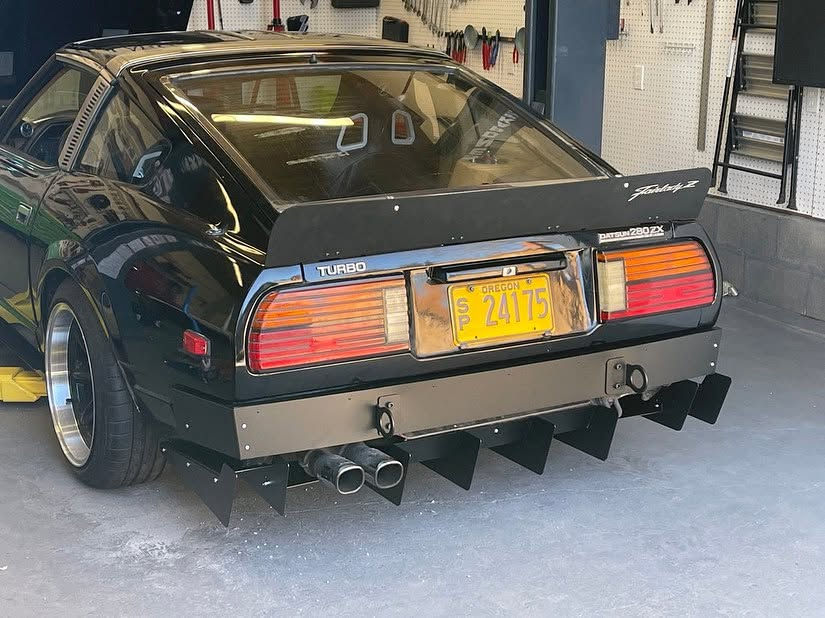
There is more here than first-generation Z hardware.
Skillard’s S130 catalog includes center consoles, rear-window louvers, adjustable rear spoilers, grilles, splitters, and other interior and exterior components. Several listings specifically provide versions for both two-seat and 2+2 cars, including consoles, rear-window louvers, and side splitters.
That model-specific detail is worth paying attention to. “Z-car part” is not a fitment specification, and even within a generation, body style and existing modifications can change what a build needs.
The catalog also reaches into the Z31 300ZX, with products including aluminum door cards and center consoles, while separate sections cover the Datsun 510, 620 pickup, and selected 370Z applications. Owners should browse by their exact model rather than assume every product family carries across the range.
Don’t skip the blog

The products are only part of the reason to spend time on Skillard’s website.
Its Form & Function series is particularly worthwhile for readers who enjoy understanding why a part looks the way it does. The discussions of consoles, door cards, and the air dam show how installation, customization, manufacturing complexity, and intended use influence the finished design.
The broader Helpful Guides section tackles ownership and modification questions, too. Articles include “How to Pick Wheel Offset and Backspacing for a 240Z,” “Carb vs EFI: Which is Best for a S30 Datsun Z?” and “Are Rear Hatch Louvers Worth It on the 240Z?” Together, they show a willingness to discuss decisions beyond the installation of a particular Skillard product.
Treat those guides as starting points for research, alongside the relevant service literature, product instructions, and measurements from your own car. The useful habit is asking the questions before ordering the parts.
Leaving room for the owner
Skillard also gives customer builds space on its website. One featured example, Paulo’s Tribute Z, was built as an homage to his father. The feature identifies the owner and credits the photographers, putting a personal story alongside the installed components.
That feels like an appropriate place to end this first spotlight.
The most interesting question about an aftermarket company is not always how many products it sells. Sometimes it is whether those products leave room for the person building the car.
Across the designs examined here, Skillard’s approach favors adaptable parts over a single prescribed finished look. A console can be left raw or upholstered. A replacement panel can be a finishing touch or the beginning of a larger interior project. The part supplies a starting point; the owner decides where to take it.
Running Skillard parts on your Datsun or Nissan? Show us your build and tell us what you changed. We’d love to feature the car—and the story behind it—on The Z Hub.
Editor’s note: This profile draws on Skillard’s published company information, product documentation, and blog. It is not a new interview or a hands-on product review.
Comments